


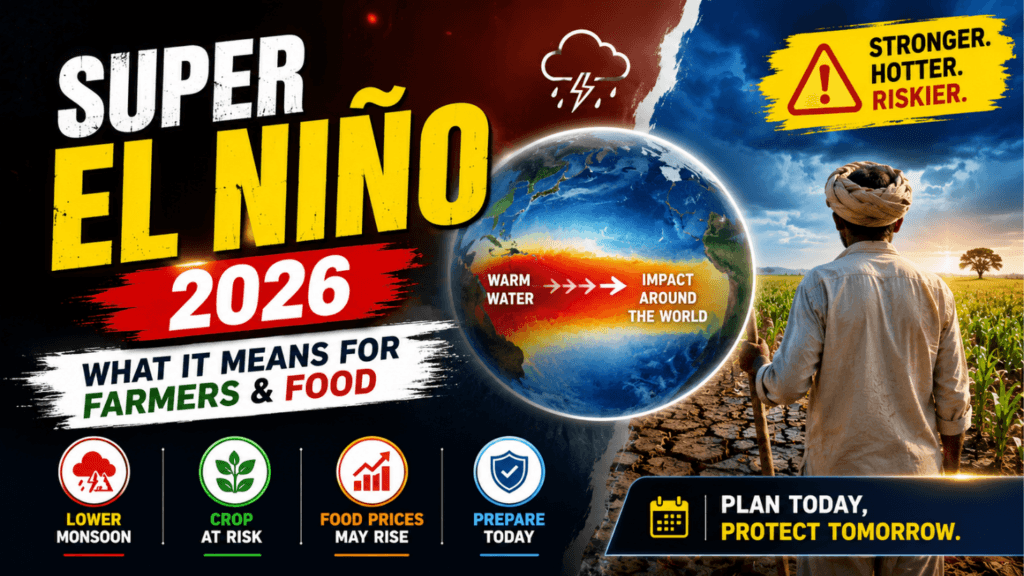
🌊 NOAA officially confirmed on June 11, 2026 that El Niño has arrived — with a 63% chance of becoming a record-breaking “Super” El Niño by winter 2026-27.
🌾 India’s IMD forecasts only 800mm of monsoon rainfall this season — 8% below normal — putting 60% of India’s farmers who depend on rain directly at risk.
🌡️ The 2026 Super El Niño may be the strongest in 150 years — stronger than 1997-98 and 2015-16 — combining with climate change to create weather the world has never seen before.
Super El Niño 2026: The Biggest Weather Event of Our Lifetime — And Why Every Farmer Must Pay Attention
Picture this.
You are standing in your field in June. The sky is clear. The winds are dry. The rains that should have arrived by now are nowhere to be seen. Your neighbor says, “Bhai, sun raha tha kuch bada aa raha hai Pacific mein.” And he is not wrong.
What is coming is called Super El Niño 2026 — and scientists at NOAA, NASA, and the World Meteorological Organization are calling it a potential once-in-150-years event. It is not a local storm. It is not a regional drought. It is a full planetary weather shift — and it is already underway.
This article explains exactly what Super El Niño 2026 is, what NOAA and IMD are officially saying, how it will affect India’s monsoon, and most importantly — what farmers and families must do right now.
What Is Super El Niño? (Simple and Clear)
Before we talk about 2026 specifically, let us understand the basics — because once you understand this, everything else clicks.
El Niño is a natural climate cycle that happens every three to seven years. Under normal conditions, strong trade winds blow from east to west across the Pacific Ocean, pushing warm surface water toward Asia and Australia. Cold, nutrient-rich water rises up near South America — this is called upwelling.
During El Niño, these trade winds weaken or even reverse direction. The warm water that was pushed west now slides back eastward toward the Americas. This massive shift of warm water in the Pacific Ocean sends shockwaves through the global atmosphere — changing rainfall patterns, temperatures, storm tracks, and drought conditions across every continent.
A “Super” El Niño is the most extreme version of this event. It is officially declared when sea surface temperatures in the monitored Niño 3.4 region of the Pacific rise more than +2.0°C above normal. This has happened only three times in modern recorded history:
- 1982–83: Severe droughts across India, Africa, and Australia; catastrophic floods in South America
- 1997–98: The strongest event on record at the time; widespread crop failures; global commodity price shocks
- 2015–16: Contributed to India’s worst drought in over 40 years; record global temperatures
And now — in 2026 — the fourth Super El Niño is developing. And current forecasts suggest it could surpass all three previous events.
What NOAA Is Officially Saying About Super El Niño 2026
This is not speculation. This is official government science.
On June 11, 2026, NOAA’s National Weather Service issued an official El Niño Advisory, confirming that El Niño conditions are now fully established in the tropical Pacific. This was announced by Ken Graham, Director of NOAA’s National Weather Service, who stated clearly that every El Niño carries its own unique imprint on global weather.
NOAA’s Climate Prediction Center has confirmed the following through its official ENSO Diagnostic Discussion:
El Niño Alert System Status: El Niño Advisory — conditions are present and expected to strengthen into Northern Hemisphere winter 2026-27.
The key numbers from NOAA’s June 2026 forecast:
- 88% probability of at least a “strong” El Niño developing by autumn 2026
- 63% probability of a “very strong” event — what scientists call Super El Niño — between November 2026 and January 2027
- 100% probability of El Niño of some magnitude continuing through the forecast period
The ECMWF (European Centre for Medium-Range Weather Forecasts), NOAA’s CFSv2 model, and Australia’s Bureau of Meteorology all agree — and all three are pointing toward a potentially historic event. Some forecast models show sea surface temperature anomalies potentially reaching +4.5°C above normal in the eastern Pacific by late 2026. If verified, that would be the strongest El Niño since 1877-78 — nearly 150 years ago.
The World Meteorological Organization (WMO), a specialized agency of the United Nations, issued a statement on June 2, 2026, warning that the developing El Niño will exacerbate drought and heavy rainfall and increase the risk of heatwaves both on land and in the ocean.
Bhai, yeh sab agencies ek saath bol rahi hain — yeh baat seedhi samajh aati hai.
What Is Happening in the Pacific Right Now?
Here is the science behind why 2026 is so alarming — and it starts underwater.
A massive oceanic Kelvin wave — an enormous pulse of warm water traveling just below the ocean surface — has been building in the western Pacific and is now moving eastward toward South America. NASA satellites detected a major Pacific sea level rise in June 2026 as this subsurface heat pulse rapidly strengthened.
As of the first week of June 2026, ocean temperatures in the El Niño monitoring region were already at their warmest levels for early June since at least 1982 — the beginning of modern satellite monitoring. The warm water pool extended from the coast of South America northward to the Pacific Northwest, and westward along the equator nearly to the Maritime Continent.
Dr. Daniel Swain, climate scientist at the University of California Agriculture and Natural Resources, put it directly: we have never experienced a strong or very strong El Niño amid pre-existing conditions that were this warm globally. The +0.2°C to +0.4°C warming from El Niño will stack on top of an already existing +1.4°C to +1.5°C of human-caused global warming. The math is troubling.
Climate simulations are forecasting what researchers are calling “shockingly high” global temperatures for November and December 2026. A Northern Illinois University meteorology professor told PBS that a strong El Niño could plausibly push global temperatures to new record levels in late 2026 and into 2027.
Super El Niño 2026 and India’s Monsoon: The Crisis at Home
Now let us talk about what matters most to farmers across India — the monsoon.
The southwest monsoon brings approximately 70% of India’s annual rainfall, roughly 870mm per year on average, from June to September. More than 50% of India’s farmed land is rainfed — entirely dependent on this monsoon. Agriculture contributes 18% of India’s GDP and supports 70% of its population.
This is what India’s India Meteorological Department (IMD) is officially forecasting for 2026:
The 2026 southwest monsoon is projected to deliver approximately 800mm of rainfall — roughly 8% below the Long Period Average of 870mm. The probability of a deficient season — rainfall below 90% of LPA — stands at 35%, more than double the historical probability of 16%.
To understand what that means practically: during the last Super El Niño in 2015-16, IMD forecast 93% of LPA, then revised it to 88%, and actual rainfall came in at 86% of LPA — with widespread drought conditions across the country.
The Indian government has already placed 150 to 200 districts on priority watch for El Niño impact — an overhaul of decade-old district contingency plans is underway at the Ministry of Agriculture. These districts are being assessed based on irrigation coverage, soil type, cropping pattern, and groundwater availability to identify where below-normal rainfall will hit hardest.
The Reserve Bank of India’s Monetary Policy Committee has officially flagged Super El Niño 2026 as a potential threat to India’s food inflation trajectory in its June 2026 monetary policy statement. When the RBI starts talking about weather in its monetary policy documents, you know the stakes are serious.
Research from IMD data shows that during El Niño periods, rice production in India decreased by an average of 3.4 million tonnes — roughly 7% of the crop. Rice, wheat, pulses, and groundnut are all significantly impacted. In global terms, El Niño causes yield reductions across 22 to 24% of global harvested area.
How Super El Niño 2026 Will Affect Different Parts of India
India is not going to be hit uniformly. Different regions face different risks.
Highest risk zones based on IMD and historical El Niño data include central and peninsular India — states like Maharashtra, Karnataka, Andhra Pradesh, Telangana, Madhya Pradesh, Chhattisgarh, and Odisha. These regions see the most severe rainfall deficits during El Niño events.
Punjab, Haryana, and northwest India — the country’s breadbasket — face a different but equally serious threat: intense heat stress. India had already recorded 60% below-normal rainfall in January-February 2026, and IMD issued heatwave alerts across Punjab, Haryana, Delhi, Rajasthan, Uttar Pradesh, Madhya Pradesh, Bihar, and Odisha earlier this year. These heat patterns are consistent with El Niño’s early signature.
One partially positive signal exists: IMD and climate scientists expect a positive Indian Ocean Dipole (IOD) to develop in the second half of the monsoon season — around August-September. A positive IOD, with warmer waters in the western Indian Ocean, can partially counteract El Niño’s suppressive effect on monsoon rainfall. This could moderate the worst-case scenario, especially for late-season rains.
However, experts caution: even a positive IOD does not eliminate the risk. The net picture is still significantly below-normal rainfall for most of India.
What Super El Niño 2026 Means for the World
The impacts extend far beyond India.
United States: NOAA forecasts extreme heat for the Desert Southwest, Texas, and California — with temperatures potentially exceeding 100°F along the Rio Grande and 110°F in the Mojave Desert. Wetter-than-average conditions along the southern tier, increased flash flood risk in the Ohio Valley and Northeast. The 2026 Atlantic hurricane season is expected to be below average — El Niño’s upper-level winds suppress hurricane development in the Atlantic.
Australia: Severe drought risk. During 1982-83 and 1997-98 Super El Niño events, Australia experienced its worst droughts in decades with major wildfire consequences.
Africa: Drought in eastern and southern Africa, particularly affecting food security in already vulnerable regions.
Global Food Prices: When harvests fall across multiple continents simultaneously — India, the US, Australia, and Africa all facing weather stress at the same time — global food commodity prices respond. The 1997-98 Super El Niño coincided with global commodity price shocks. Economists at Stanford University have found that El Niño can slow American economic growth overall, with effects cascading through global supply chains.
What Should Farmers Do Right Now?
This is the most important section — practical steps based on official IMD and government advisories.
Shift to drought-tolerant crops. IMD and Skymet Weather both urge farmers in deficit-forecast regions to avoid water-intensive paddy cultivation. Millets — bajra, jowar, ragi — are your best friends in a below-normal monsoon year. Short-duration pulses and oilseeds are also better choices than rice in dry-prone districts.
Harvest every drop of rainwater. Farm ponds, bunds, check dams — every water conservation structure on your land becomes ten times more valuable in a weak monsoon year. If you have been delaying construction, delay no more.
Check your groundwater before sowing. Reservoir levels in India have already shown a concerning trend — a drop of 8 billion cubic meters in just two weeks in May 2026, according to the Central Water Commission. Do not assume groundwater will bail you out if rains fail.
Get crop insurance now. The Pradhan Mantri Fasal Bima Yojana (PMFBY) is active — enroll before the deadline for Kharif 2026. In a drought year, this is the difference between manageable loss and financial ruin.
Stay connected with local IMD alerts. The government has activated early warning systems, crop advisory services, and district-level contingency plans. Your state agriculture department and Kisan Call Center (1800-180-1551) will issue regular advisories as the season unfolds.
The Bigger Picture: Climate Change Makes Super El Niño More Dangerous
Here is the uncomfortable truth that scientists are openly discussing.
A December 2025 study published in the journal Nature Communications found that Super El Niño events can drive sudden Climate Regime Shifts — sudden, long-lasting changes in the climate system that affect ecosystems, soil moisture, rainfall, and human livelihoods for years or even decades.
In 2026, El Niño is not happening in a normal world. It is happening on top of a climate system that is already 1.4°C warmer than pre-industrial levels — the warmest conditions in which humanity has ever experienced a Super El Niño. The warming from El Niño and warming from human-caused climate change are additive: they stack on each other.
“We have never experienced a strong or very strong El Niño amid pre-existing conditions that were this warm globally,” said Dr. Daniel Swain of UC Agriculture and Natural Resources. “It would not be surprising to see some unprecedented global impacts.”
The world is entering uncharted territory — and the people who will feel it first, and feel it hardest, are farmers.
FAQ: Super El Niño 2026
Q1. What is Super El Niño 2026 and when did it officially start?
NOAA officially declared El Niño conditions on June 11, 2026. It is classified as a “Super” El Niño when Pacific sea surface temperatures exceed +2°C above normal. NOAA gives a 63% chance of this threshold being crossed by November-January 2026-27.
Q2. How will Super El Niño 2026 affect India’s monsoon?
IMD forecasts India will receive approximately 800mm of monsoon rainfall in 2026 — about 8% below the long period average of 870mm. The probability of a deficient season is 35%, more than double the historical norm.
Q3. Which crops will be most affected in India?
Rice, wheat, pulses, and groundnut are most at risk. During El Niño years, rice production in India has historically declined by an average of 3.4 million tonnes, or about 7% of the crop.
Q4. Is Super El Niño 2026 the strongest ever?
Forecasts from NOAA, ECMWF, and other agencies suggest it could become the strongest El Niño since 1877-78 — potentially surpassing the 1997-98 event. Some models show anomalies reaching +4.5°C, but forecasts will evolve through the season.
Q5. Which states in India are at highest risk?
Central and peninsular states — Maharashtra, Karnataka, Andhra Pradesh, Telangana, Madhya Pradesh, Chhattisgarh — face the greatest rainfall deficit risk. Punjab, Haryana, Rajasthan, UP face extreme heat stress.
Q6. What is the Indian government doing about Super El Niño 2026?
The Ministry of Agriculture has placed 150-200 districts on priority watch and is overhauling decade-old district contingency plans. IMD is issuing regular forecasts. PMFBY crop insurance and Kisan advisory services are active.
Q7. Will there be food price inflation due to Super El Niño 2026?
The RBI’s June 2026 monetary policy statement explicitly flags Super El Niño as a risk to India’s food inflation trajectory. Global food prices are also at risk as multiple major agricultural regions face weather stress simultaneously.
Q8. Can anything reduce the impact on India’s monsoon?
A positive Indian Ocean Dipole (IOD), expected to develop in August-September 2026, could partially offset El Niño’s suppressive effect. However, experts say this moderation is partial and the overall monsoon picture remains below normal.
The Bottom Line
The Super El Niño 2026 is not a news headline to scroll past. It is a planetary-scale weather event that is already reshaping rainfall patterns, temperature records, and agricultural forecasts across the world — and it will intensify through the rest of 2026 into 2027.
For India, the message from IMD, NOAA, WMO, and the government is clear: prepare now. Choose drought-tolerant crops. Conserve water. Get crop insurance. Stay connected with official advisories.
Bhai, kisaan ko koi darana nahi — but seedha baat hai: is saal mausam ne apna rang dikhana shuru kar diya hai. Jo taiyaar hai, woh bachega. Jo ankh bandh karke baitha hai, woh pachtayega.
The Pacific is warming. The monsoon is under threat. And the time to act is now — not when the rains fail, but before they do.
Sources: NOAA National Weather Service (noaa.gov), NOAA Climate Prediction Center (cpc.ncep.noaa.gov), India Meteorological Department (imd.gov.in), World Meteorological Organization (wmo.int), Ministry of Agriculture Government of India, Reserve Bank of India Monetary Policy Statement June 2026, Central Water Commission (cwc.gov.in)