
There’s no single “best” tractor for every farmer — the right choice depends on your land size, the crops you grow, your soil type, and your budget. But some brands and models have earned their reputation across India’s farms for a reason. This guide breaks down who’s actually leading the market in 2026, what each top model costs, and how to pick the right one for your field instead of just the most popular one.
How We Picked These Models
Rather than ranking by opinion, this list is built around three things that actually matter to a working farmer: current market share (what’s proven and easy to get serviced), price-to-HP value (what you’re paying per horsepower and per kg of lifting capacity), and warranty backing (how much risk the manufacturer is willing to absorb, which tells you a lot about build confidence). Prices below are approximate ex-showroom ranges — actual on-road price will vary by state due to RTO tax, insurance, and dealer margin, so always confirm locally before booking.
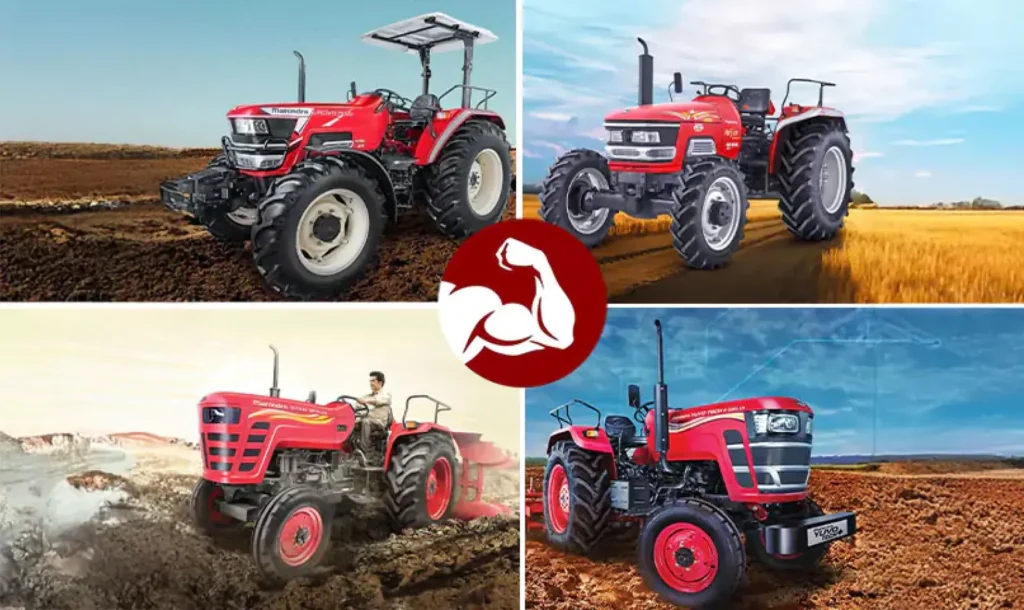
Who’s Winning the Tractor Market in 2026
India’s tractor market crossed 10 lakh retail units for the first time this year, driven by a strong monsoon and healthy rural cash flow, with retail sales up over 28% year-on-year as of mid-2026. Here’s how the top brands stack up by market share:
| Brand | Approx. Market Share | Known For |
|---|---|---|
| Mahindra | ~24% | Widest HP range (15–75 HP), strongest dealer network, best resale value |
| Swaraj | ~19% | Mechanical simplicity, easy field repairs, strong fuel efficiency |
| Sonalika | ~13% | Competitive pricing, fast-growing market share, good power-to-price ratio |
| Escorts Kubota (Powertrac/Farmtrac) | ~11% | Value-focused, popular in North India |
| TAFE / Massey Ferguson | ~11% | Feature-rich, globally proven engineering |
Together, these five brands account for nearly 80% of every tractor sold in the country.
Best Tractors by Farm Size
Small Farms (Under 5 Acres) — 20–33 HP
If you’re farming a small plot, working in orchards, or need a tractor mainly for light haulage, you don’t need to overspend on horsepower — you’ll just burn more diesel for no benefit.
Mahindra 275 DI TU
- 28 HP | 2WD | 1817 CC engine | 24 HP PTO | 1000 kg lifting capacity
- Approx. price: ₹5.5–6 lakh (ex-showroom)
- Pros: Lowest running cost in its class, huge Mahindra dealer network means parts are never far away, strong resale value
- Cons: Limited to light-to-medium implements; not built for heavy haulage
- Best for: Small landholders, orchard work, and farmers prioritizing low maintenance over power
Swaraj 735 FE
- 33 HP | 2WD | 2156 CC engine | 30 HP PTO | 1200 kg lifting capacity
- Approx. price: ₹5.83–6.18 lakh (ex-showroom)
- Pros: One of the best-selling models in this segment; mechanically simple, so local mechanics can service it easily
- Cons: 2WD only limits traction on wet or sandy fields
- Best for: Wheat-paddy rotation farming on small-to-medium plots with firm soil
Medium Farms (5–15 Acres) — 44–50 HP
This is the segment where most North Indian farmers land — enough power for ploughing, rotavation, and general haulage without excessive fuel cost.
Swaraj 744 FE
- 47–48 HP | 2WD/4WD options | 3307 CC engine | ~41.8 HP PTO | 2000 kg lifting capacity
- Approx. price: ₹7.3–7.8 lakh (2WD); ₹8.7–9.05 lakh (4WD)
- Warranty: 6 years / 6,000 hours — one of the longest in the segment
- Pros: Long warranty reduces ownership risk considerably; strong torque for heavy implements; oil-immersed brakes and 13.6×28 tyres give good field grip
- Cons: Slightly premium pricing versus Mahindra’s 575 in the same HP band; heavier build can trim mileage slightly
- Best for: Farmers who want long-term warranty security over the lowest sticker price
Mahindra 575 DI XP Plus
- 47 HP | 2WD | 2979 CC 4-cylinder engine | 1500 kg lifting capacity
- Approx. price: ₹7.3–7.9 lakh (ex-showroom), under ₹8 lakh on-road in most states
- Warranty: 6 years / 6,000 hours
- Pros: Excellent fuel efficiency for its power class, smooth 8F+2R transmission, very strong resale value thanks to the Mahindra badge
- Cons: Lower lifting capacity than the Swaraj 744 FE at a similar price point
- Best for: Farmers running wheat, rice, or sugarcane who want Mahindra’s service network without paying for 4WD they don’t need
Sonalika DI 750 III
- 55 HP | 2WD/4WD options | 3707 CC 4-cylinder engine | ~43–46 HP PTO | 2000–2200 kg lifting capacity
- Approx. price: ₹7.16–8.18 lakh (2WD); ₹8.8 lakh+ (4WD)
- Warranty: Typically 2 years/2,000 hours standard, extendable to 5 years on select variants
- Pros: Strong torque for sugarcane haulage and heavy-duty transport work, indigenously built engine, good value per HP
- Cons: Standard warranty is shorter than Swaraj/Mahindra unless you pay for the extended plan
- Best for: Farmers who need more raw power and haulage capacity without jumping to a 4WD-only large-farm tractor
Large Farms (15+ Acres) — 55+ HP
For heavy-duty ploughing, large implements, or commercial haulage work, you need the extra torque and lifting capacity — and the fuel budget to match.
John Deere 5105
- 45 HP | 2WD | 2900 CC engine | 1600 kg lifting capacity
- Pros: Known across India for engine longevity and low breakdown rates; strong choice if you’re running the tractor for 10+ years
- Cons: Higher upfront cost than equivalent Mahindra/Swaraj models; service network is less dense in smaller towns
- Best for: Farmers prioritizing long-term reliability over lowest purchase price
Sonalika Tiger DI 60
- 55 HP | 4WD | 3310–4712 CC engine (variant-dependent) | 2100–2200 kg lifting capacity
- Pros: Strong 4WD traction for hilly or uneven terrain, competitive pricing versus John Deere in the same HP class
- Cons: Standard warranty shorter than premium brands
- Best for: Larger farms with uneven or wet terrain needing serious traction
John Deere 5310
- 55 HP | 4WD | 2900 CC engine | 2000–2200 kg lifting capacity
- Pros: Premium build quality, strong resale value, widely regarded as one of the most reliable 55 HP 4WD tractors in India
- Cons: Highest price point in this list; parts and service can cost more than Indian brands
- Best for: Farmers running larger operations or contract farming who value long-term durability over upfront savings
How to Actually Choose (Not Just Which Brand Sells the Most)
Market share tells you what other farmers are buying — it doesn’t tell you what’s right for your field. Before you decide, weigh these factors:
- Match HP to your land, not your budget. Buying more horsepower than you need burns diesel for no benefit. Buying less means you’ll strain the engine and wear it out faster.
- Check PTO power, not just engine HP. If you run a rotavator, thresher, or other implement off the PTO, the PTO horsepower rating matters more than the headline engine HP — a tractor with lower engine HP but strong PTO output can outperform a “bigger” tractor on implement-heavy work.
- Warranty length is a signal, not just a safety net. A 6-year/6,000-hour warranty (like Swaraj 744 FE or Mahindra 575 DI XP Plus) tells you the manufacturer trusts the build enough to absorb six years of risk. A shorter 2-year standard warranty isn’t necessarily a red flag, but factor in the cost of an extended plan before comparing prices directly.
- Service network matters more than spec sheets. A tractor that breaks down during sowing season with no nearby service centre costs you more than any price difference between brands. Check how many authorised dealers/service points exist within your district before buying, not just in your state.
- 2WD vs 4WD depends on your soil, not your budget alone. 4WD costs ₹1–1.5 lakh more upfront but pays off on wet, sandy, uneven, or hilly fields where 2WD tractors lose traction and spin their wheels — which wastes fuel and time during exactly the windows (sowing, harvest) when you can least afford delays.
- Fuel efficiency compounds over years, not just per tank. A tractor with slightly better Specific Fuel Consumption (SFC) can save you thousands of rupees a year once you’re running 400+ hours annually. Ask your dealer for the CFMTTI Budni-tested SFC figure, not just the marketing claim.
Frequently Asked Questions
Which tractor brand has the highest market share in India in 2026?
Mahindra leads with roughly 24% market share, followed by Swaraj (~19%) and Sonalika (~13%). These figures shift slightly month to month based on FADA retail sales data.
What is the best tractor for a small farmer under 5 acres?
For plots under 5 acres, a 28–33 HP model like the Mahindra 275 DI TU or Swaraj 735 FE is usually enough power without unnecessary fuel cost. Going above 35 HP on a small plot rarely pays for itself.
Is a 4WD tractor worth the extra cost?
Only if your soil demands it. On firm, dry, level fields, 2WD is cheaper to buy and run. On wet, sandy, or uneven terrain, 4WD’s better traction reduces wheel-spin and saves time and fuel — the extra ₹1–1.5 lakh pays back faster than most farmers expect.
Which tractor has the longest warranty in India? Several Swaraj and Mahindra models in the 45–50 HP range offer 6 years/6,000 hours as standard, among the longest in the industry. Always confirm the exact warranty terms for the specific variant, since they can differ within the same model name.
How much does a 50 HP tractor cost in India in 2026? Expect to pay roughly ₹7–9 lakh ex-showroom for a 45–50 HP tractor from a major brand, depending on 2WD/4WD, variant, and state taxes. On-road price typically runs 5–10% above ex-showroom once insurance and registration are added.
Compare Before You Buy
Rather than relying on brand reputation alone, compare exact specifications — horsepower, PTO power, lifting capacity, and transmission — side by side for the models you’re considering.
Compare Tractor Specifications →
You can also browse verified tractor listings and current prices across 28 districts on our Tractor News page, updated daily.
Have a specific budget or farm size in mind? Drop your requirement on our WhatsApp channel and our team can help shortlist the right model for you.
